This article covers the key configuration settings that connect Visualcare to government funding schemes (NDIS, Support at Home, CHSP) and your accounting software. It also covers the Support at Home (SAH) transition tools, including the migration dashboard and CHSP migration wizard.

Custom layout settings

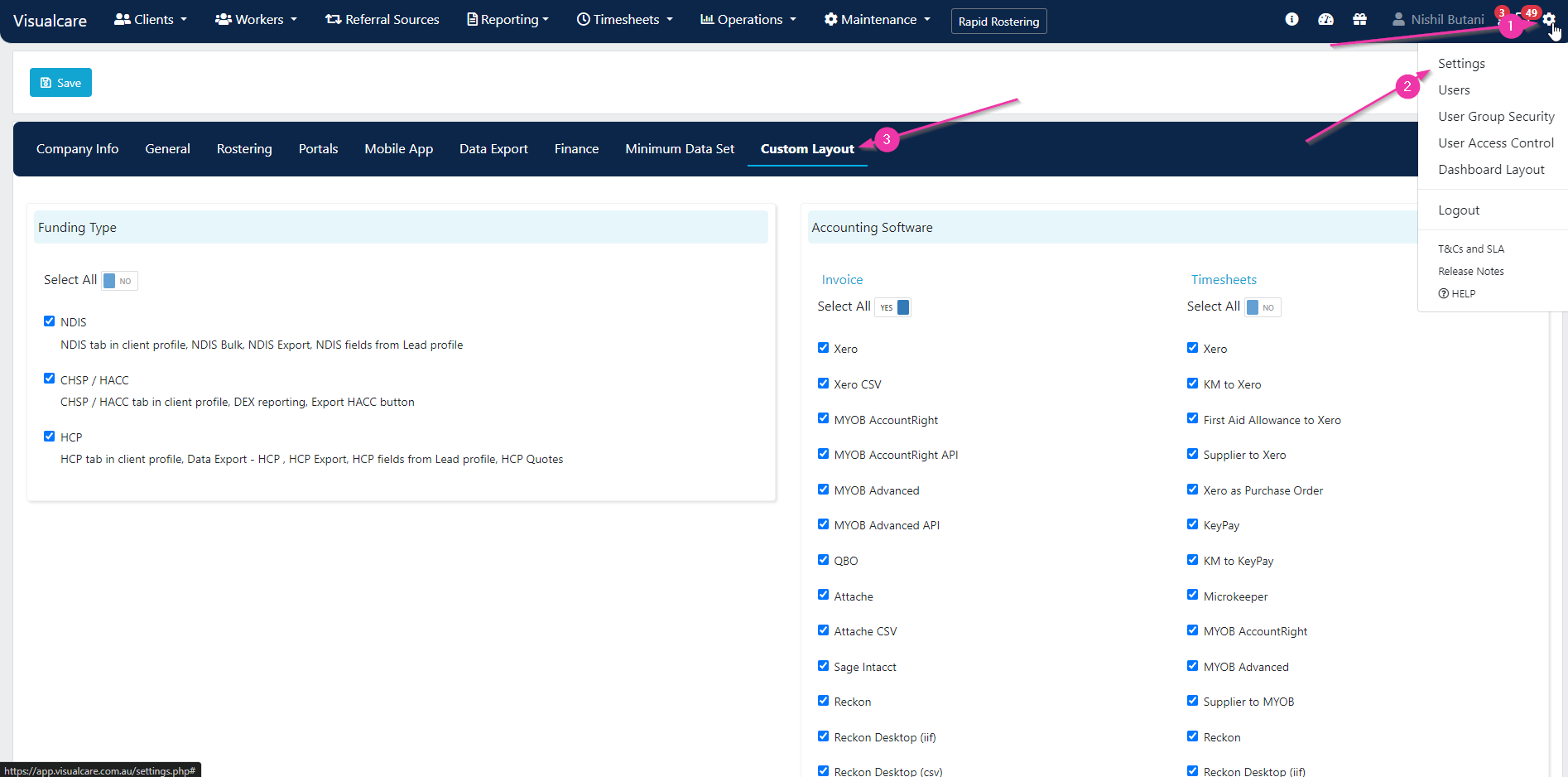
Custom layout settings control which funding types and features are visible across VCore for all users. Navigate to SettingsCustom Layout. Custom layout settings

Funding types

Select which funding types you want to display in VCore:
  • NDIS
  • CHSP/HACC
  • HCP (now transitioning to Support at Home)
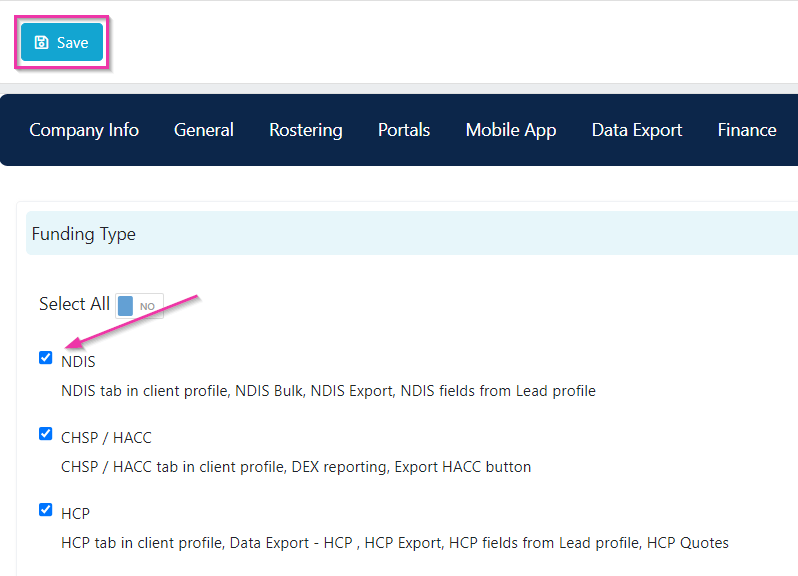
Click Save after making your selections. Fields and functionality throughout VCore will show or hide based on these selections. Funding type selection

Accounting software

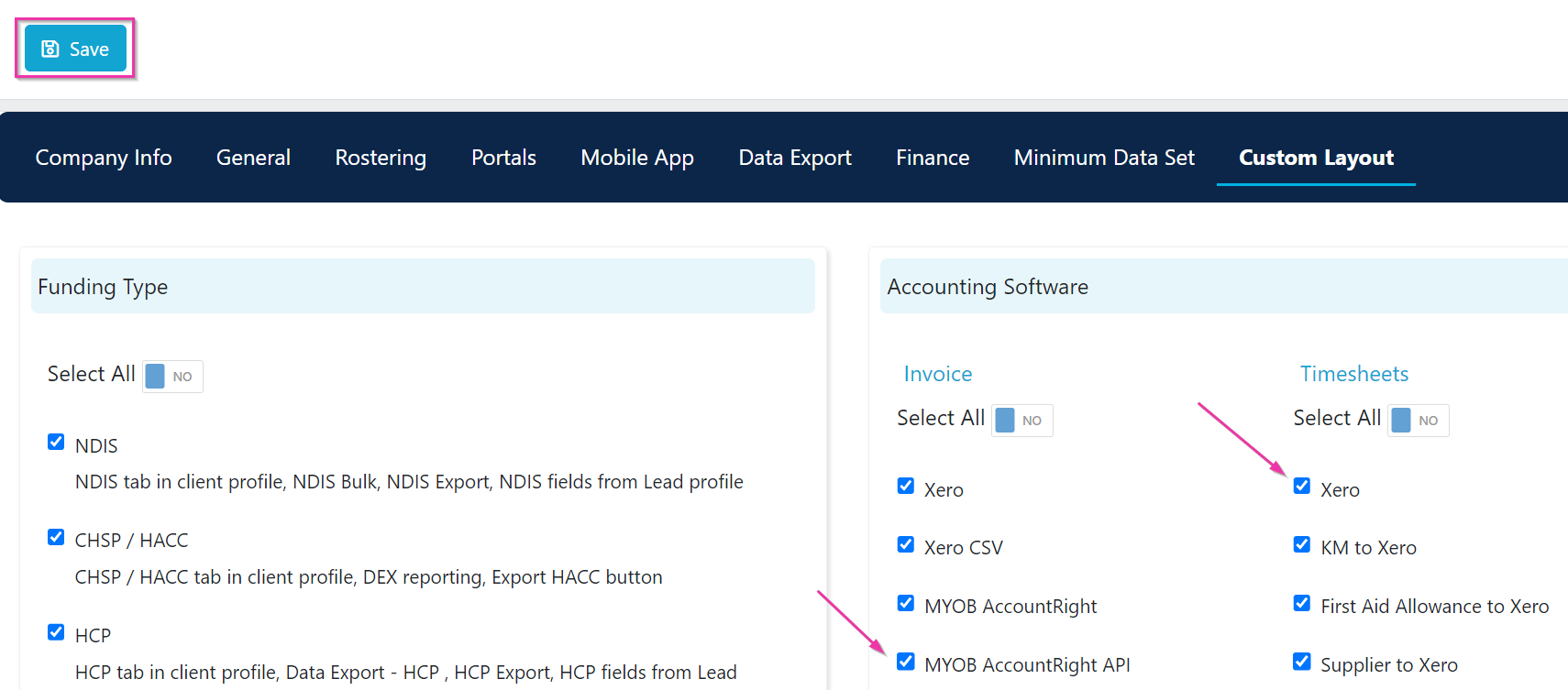
Select your accounting software from the drop-down. This determines what appears on the data export page when exporting invoices and timesheets. Accounting software selection
Company information and government IDs

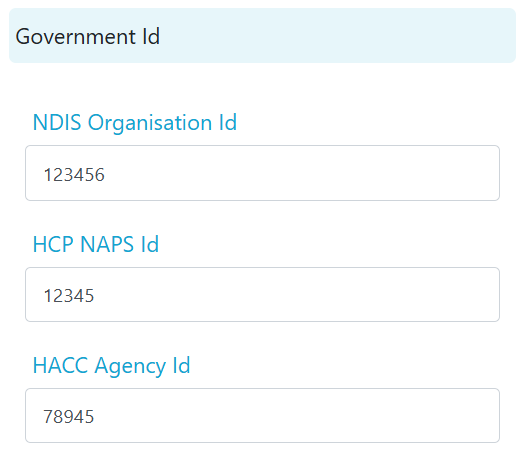
Your organisation’s government identifiers are set under SettingsCompany Info. These link directly to the claiming functionality for different funding sources. Company information settings Under this section, add or edit your company information including:
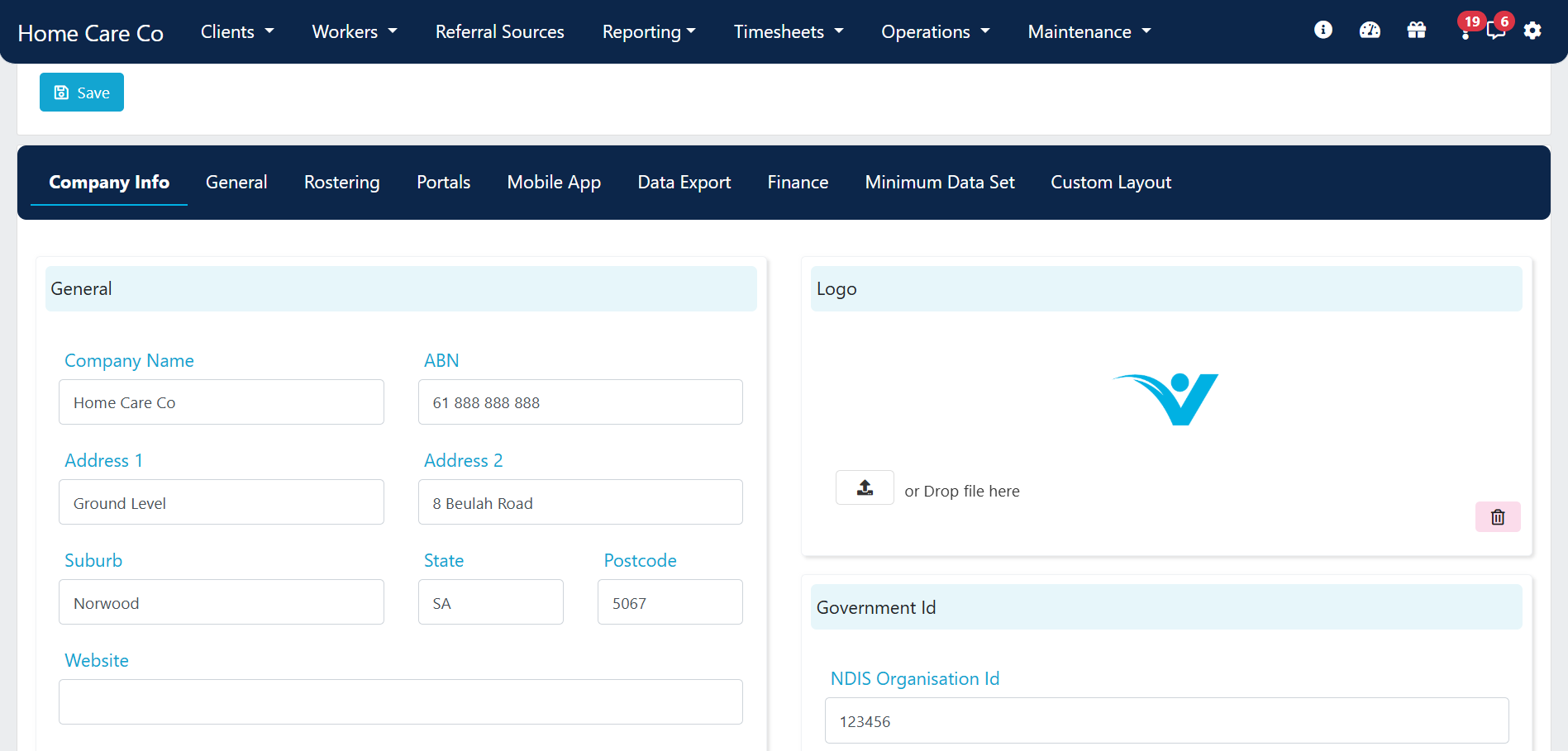
  • Business address
  • ABN
  • Phone number
  • Company logo
  • Time zone
Click Save after making changes.

Government ID fields

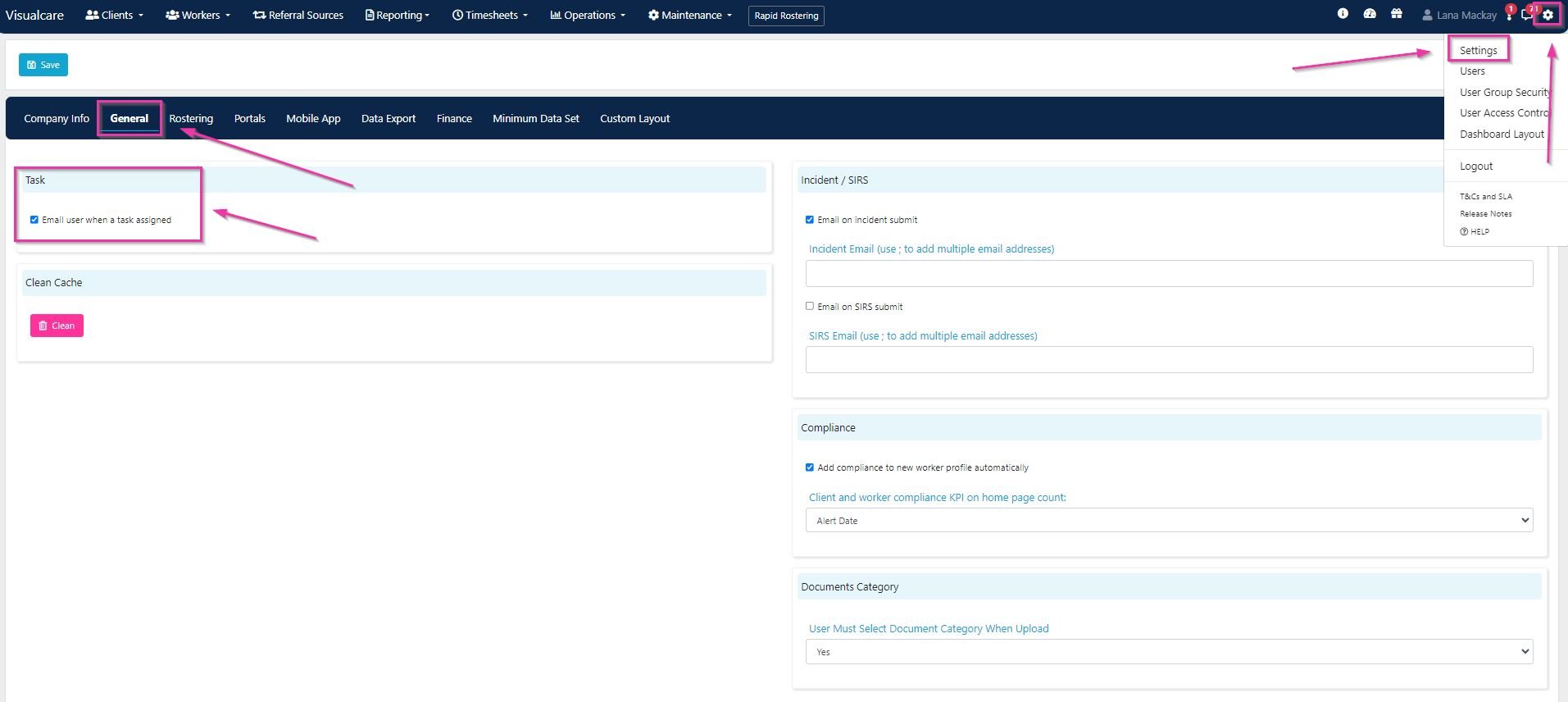
Government ID fields Several settings in SettingsGeneral affect operational features across VCore.

Task email notifications

To have all VCore users receive an email when a task is assigned to them, tick Email user when a task assigned and click Save. Task email settings
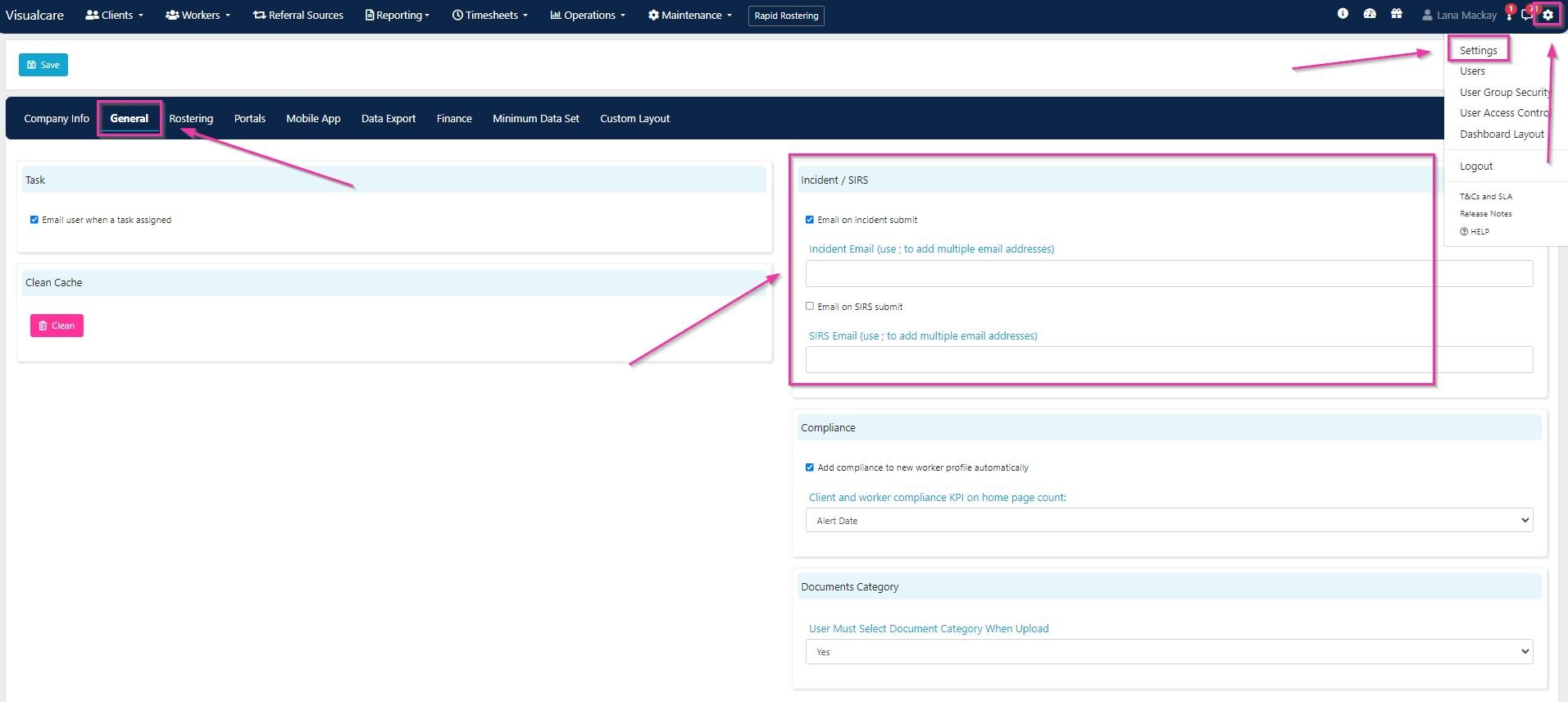
Incident and SIRS notifications

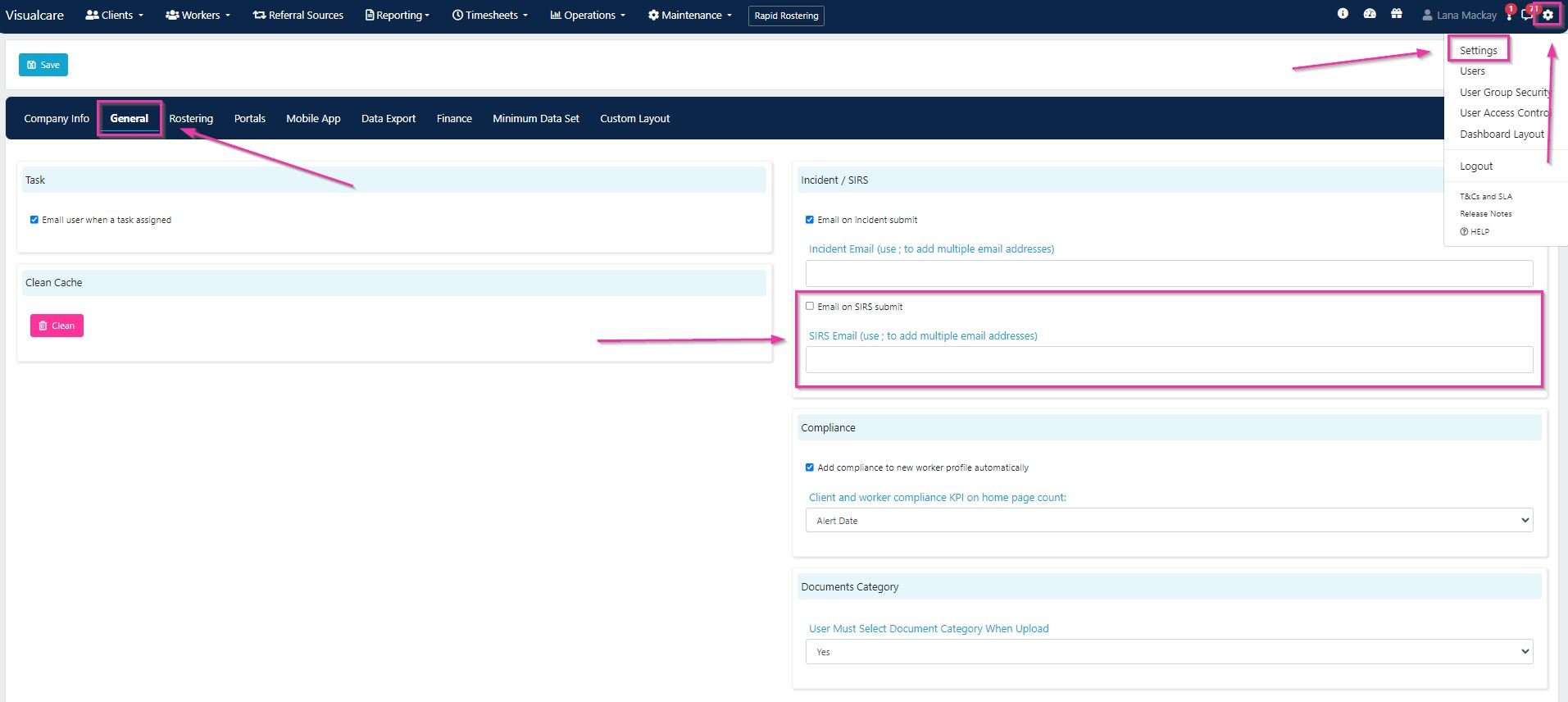
To notify specific employees by email when an incident report is submitted, add their email address under the incident section and tick Email on incident submit. Use a semicolon (;) to separate multiple email addresses. Incident email settings For Serious Incident Response Scheme (SIRS) notifications, add the email address and tick Email on SIRS submit. SIRS email settings
Compliance settings

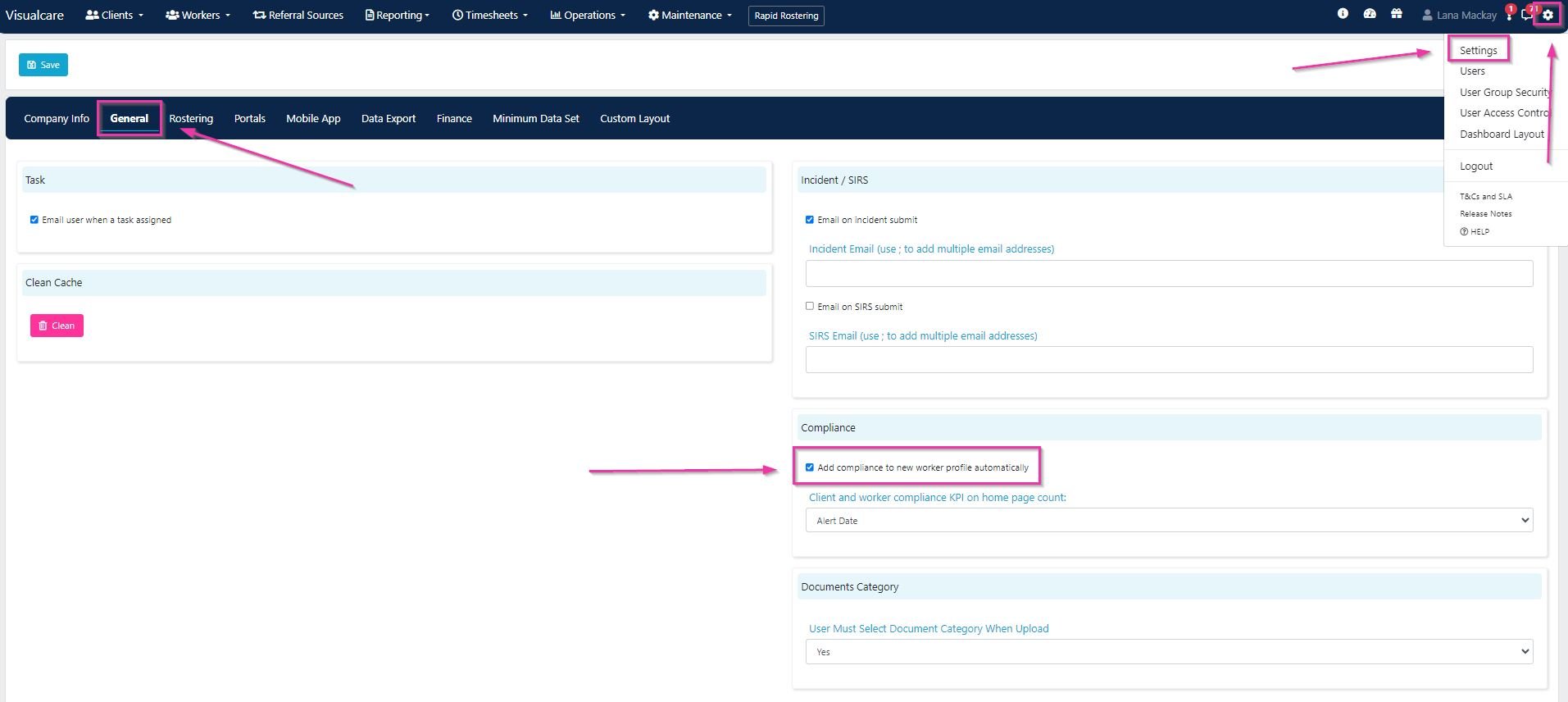
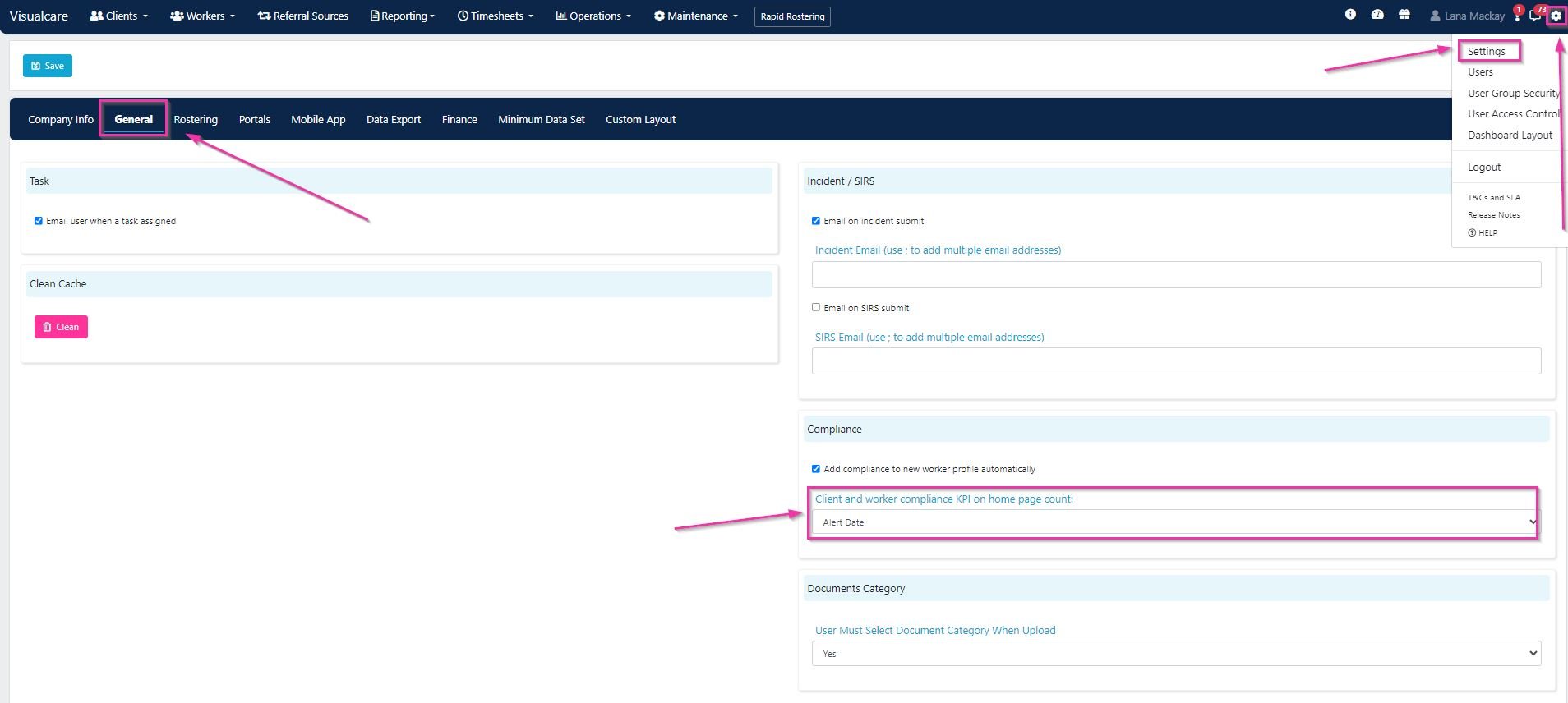
To automatically add compliance items to new worker profiles, tick Add compliance to new worker profile automatically. Compliance auto-add setting To set which date the worker compliance KPI tile on the VCore home page uses, select Alert Date or Expiry Date from the drop-down. Compliance KPI date setting
Document category requirement

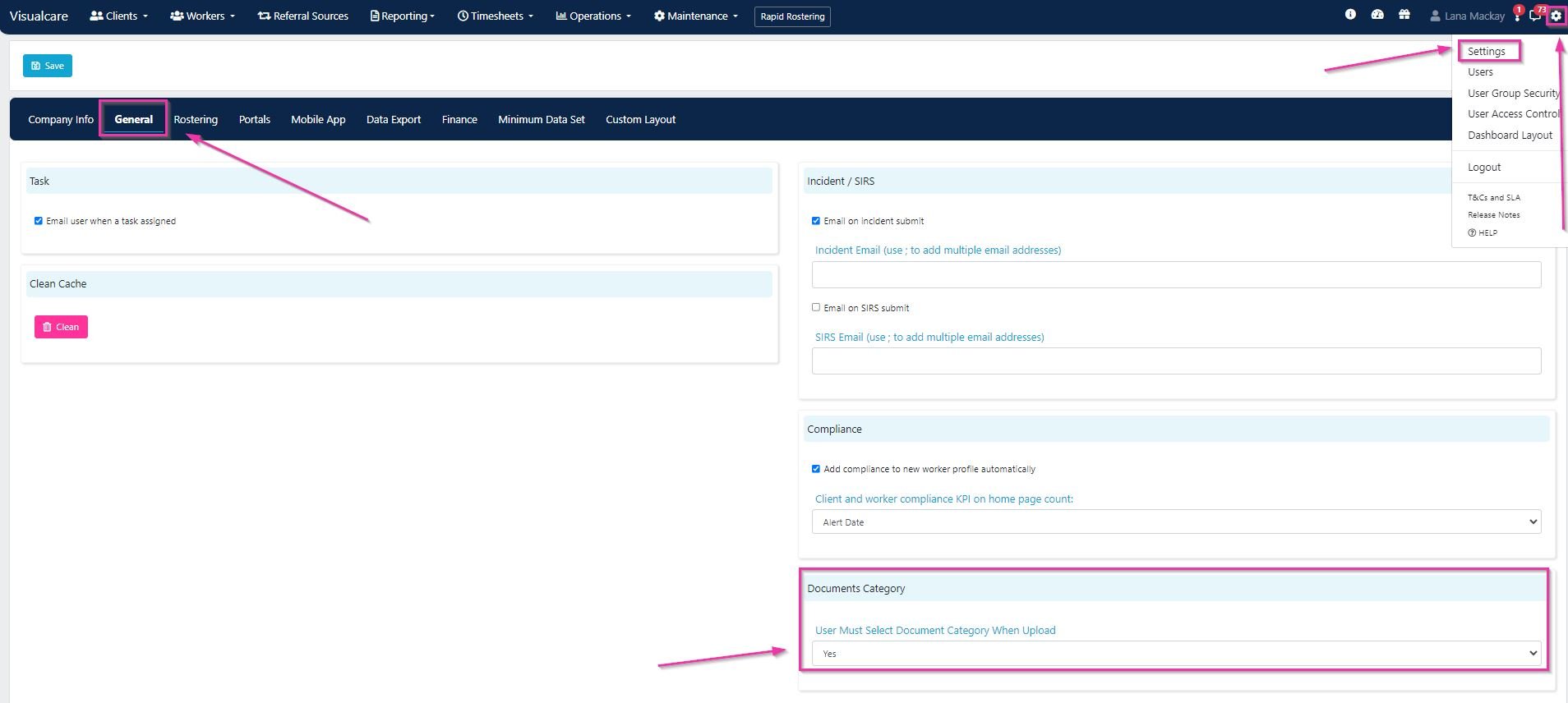
To require users to select a document category when uploading documents, set User Must Select Document Category When Upload to Yes. Document category setting
Support at Home (SAH) transition

The Support at Home Program is the Australian Government’s funding model that replaced Home Care Packages (HCP) from 1 November 2025. The Commonwealth Home Support Programme (CHSP) will transition in 2027.

Key differences: HCP vs SAH

SAH funding structure

Care management

10% of the ongoing budget is automatically allocated to care management. The Care Management Pool (CMP) is quarantined for care coordination activities delivered by care partners.

SAH migration dashboard

The SAH migration dashboard helps you transition from HCP to SAH services. Access it from OperationsSAH Dashboard. SAH readiness dashboard
Step 1 (Services) is only available to users who have security permissions to access the MaintenanceServices page.
The dashboard has four steps:

Step 1: Service migration

Map your existing HCP services to the new SAH services from the government-defined service list. This page lists existing services with the Home Care Package service type. Work through the list and select the applicable SAH service for each HCP service. Service mapping list
Services need to have “Home Care Package” as the service type to appear in the dashboard. If a service shows as blank or “HCP”, update the service type under MaintenanceServices before using the mapping tool.
Mapping one HCP service to multiple SAH services: If one HCP service needs to become multiple SAH services, tick all that apply and click Submit. Multiple SAH service mapping The tool shows a Create new services? window where you can edit service descriptions before clicking Confirm. Confirm new services Once all updates are made and confirmed, the completed HCP service is removed from the list. Use the Show / Hide Completed button to review or edit completed items. Show/hide completed Bulk mapping option: Use the Download and Upload buttons to map services in bulk via a spreadsheet. Mapped SAH services can be selected from the drop-down in the downloaded file. Completed items are highlighted in green. Bulk download and upload Once all services are mapped, Step 1 shows a “complete” tick. Step 1 complete
After mapping, you can still update individual service details (charge rate, pay rate, accounting codes) under MaintenanceServices, or in bulk using the Import CSV function under MaintenanceServicesAll Services. Note that if a mapped “parent” SAH service charge rate is updated, it overrides the “child” HCP original service rate.

Step 2: Agreement migration

The tool clones HCP agreements and creates new SAH agreements:
  • HCP agreements with the Home Care Package funding type are cloned and end-dated
  • A new SAH agreement begins with the appropriate start date
  • A care management service is created and added to the new agreement
Where one HCP service was mapped to multiple SAH services in Step 1, you can review and select which services to include in the new SAH agreement.
If a participant has been approved for Assistive Technology-Home Modifications, Short Term Restorative Care, or End of Life Care, these need to be set up as separate agreements. Where a care management service has been added, you may need to add additional information (charge rate, accounting code) under MaintenanceServices.

Step 3: Roster migration

The roster step transfers all shifts from the transition date forward, updating services on shifts from the old HCP agreement to the new SAH agreement as mapped in the previous steps.
Where services need to be split for accurate SAH claiming (for example, splitting “Domestic Assistance” into separate house cleaning and laundry activities), additional roster customisation is needed manually. If existing HCP agreements end before the transition date, new SAH agreements and rosters need to be created separately.

Step 4: Participant profiles

This step handles participant profile updates for the SAH transition.

Transition considerations

  • Finalise HCP claims - for transitioned HCP participants, SAH claiming cannot be processed until all HCP claims have been finalised
  • Provider registration - ensure your organisation is registered for the SAH service categories you provide
  • Accounting software - update your customer list, service items, and accounting codes in preparation for split invoicing
  • Service mapping - take time to correctly map HCP services to SAH equivalents
  • Agreement review - review new SAH agreements before activating
  • Staff training - ensure care partners understand the new care management tracking requirements
  • Form updates - if using JotForms with HCP information, contact Visualcare support to request updates for SAH
Participants receiving HCP on or before 12 September 2024 have protected contribution rules. All participants move to SAH claiming through Visualcare. There is no option to remain in the old HCP system, but transitional rules apply.

CHSP migration

As of 1 July 2025, Stage 1 of the Support at Home reform is in effect for all CHSP providers. A new CHSP service list has replaced the old services, and DEX rejects any activity reported using outdated codes for services from 1 July.

What changed

All CHSP services now use new service types and program activities. CHSP services delivered from 1 July 2025 need to be mapped to the new codes before July data is lodged in August. Legacy codes that can no longer be used:
  • ATSI Health Worker (ID 29)
  • Hydrotherapy (ID 105)
  • Nursing (ID 58)
  • Ongoing Allied Health and Therapy Services (ID 34)
  • Other Allied Health and Therapy Services (ID 35)
  • Restorative Care Services (ID 39)
  • Other Goods and Equipment (ID 48)
All other CHSP codes are mapped to their updated equivalents upon migration.

Running the CHSP migration wizard

1

Request new program activity approval

Request approval for new program activities in the DEX portal before running the migration in Visualcare.
2

Launch the CHSP migration wizard

Click the Migrate button from the banner at the top of your screen in Visualcare.CHSP migration banner
3

Upload your organisation data file

Drag and drop your .XML file, or click Upload a file to select it. The wizard checks the file before upload and flags any required actions.Upload organisation data file
4

Start migration

Click Start Migration. The tool matches old service types to the new CHSP services, updates DEX Case and Activity fields on agreements, rosters, and timesheets, and creates new DEX cases for approved program activities.Start migration button

CHSP migration troubleshooting

When this occurs:
  • The incorrect file format is uploaded (for example, .csv or .pdf)
  • A file with incorrect structure or content is uploaded
What to do:
  • Download the OrganisationData.xml file from the DEX portal and try uploading again File upload error
When this occurs:
  • A backend error occurs due to system processing issues (rare)
What to do:
When this occurs:
  • The provider has previously delivered services that have not been approved in the current OrganisationData file
  • These activities cannot be mapped and prevent the migration from completing
What to do:
  • Review the instructions on the screen
  • Use the DEX portal to request approval for the missing activities
  • Once approved, re-upload the updated OrganisationData file and re-run the migration Migration failure

SAH glossary

Running into issues?

See General troubleshooting for common errors and fixes.

Service management

Set up and manage services, charge rates, and pay rates

Import CSV

Import records in bulk using CSV files

Editing drop-down lists

Manage areas, payers, and other configuration lists